
Grammar Basics: Understanding Korean Sentence Structure
Korean grammar works differently than English. We’ll break down the core patterns that’ll help everything click into place. No matter where you’re starting from, you’ll see how the pieces fit together.

Why Korean Grammar Feels Different
When you first look at Korean sentences, they probably seem backward. The verb comes at the end. The object sits before the subject. Particles do things that prepositions handle in English. It’s not that Korean is harder — it’s just organized differently.
Here’s what’s really happening: Korean grammar follows a logic. Once you understand the core structure, you’re not memorizing rules. You’re recognizing patterns. And patterns stick with you because your brain naturally looks for them.
We’re going to walk through the fundamental building blocks. By the end of this, you’ll see how a Korean sentence actually assembles itself. You’ll understand why things go where they go.

The Core Structure: Subject-Object-Verb
English is Subject-Verb-Object. “I eat rice.” The action happens in the middle. Korean flips this. It’s Subject-Object-Verb. “나는 밥을 먹어요” (I rice eat). The verb comes last, after everything else settles into place.
This isn’t random. Think of it as building suspense. In Korean, you’re setting up all the pieces before revealing the action. The listener knows what you’re talking about and what’s happening to it before you tell them what you’re doing. It creates a natural flow once you get used to it.
Basic pattern: Subject + Object + Verb + Ending
나 (I) + 밥을 (rice) + 먹어요 (eat)
The beauty? Once you know this order, you’ve unlocked something fundamental. Every sentence you encounter will follow this pattern. That’s not a limitation — it’s consistency you can build on.

Particles: The Grammar Glue
Particles are where Korean grammar gets interesting. These small markers — 은, 는, 을, 를, 에, 에서 — attach to words and tell you their role in the sentence. They’re like grammatical labels.
In English, word order does this job. “The dog bit me” vs. “Me bit the dog” — order tells you who did what. Korean uses particles instead. The word can move around more flexibly because the particle clarifies its function.
- 은/는 — Topic marker. Shows what you’re talking about.
- 을/를 — Object marker. Shows what’s being affected.
- 이/가 — Subject marker. Emphasizes the doer.
- 에 — Location or destination. Where something is or goes.
- 에서 — Starting point or location of action.
You’ll notice that 은/는 and 이/가 both mark the subject. Here’s the practical difference: 은/는 sets up your topic (what you’re discussing), while 이/가 emphasizes who specifically is doing something. Most of the time in conversation, you’ll see 은/는.
Verb Endings: Tense, Politeness, and Mood
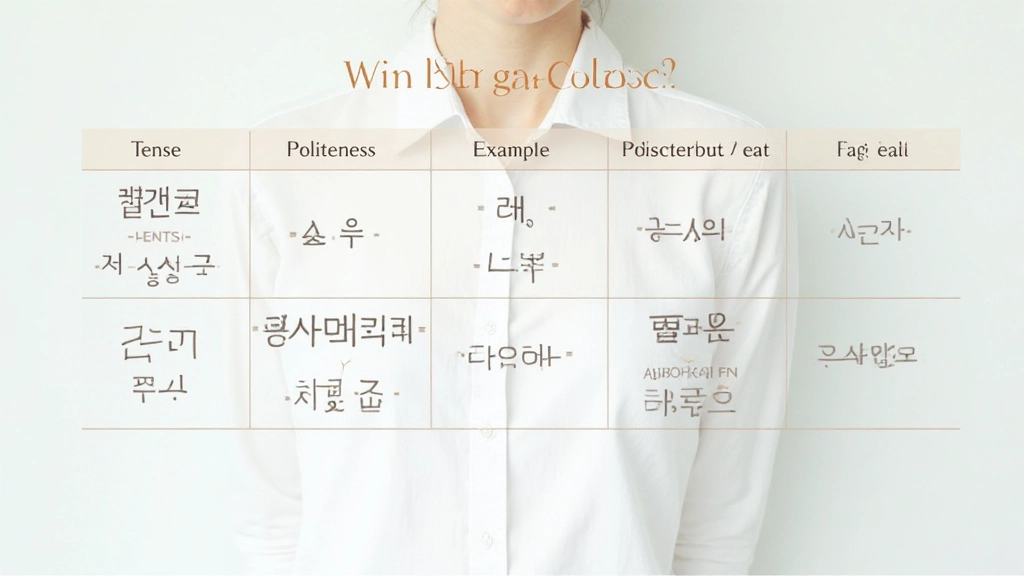
Korean verbs don’t change form like English verbs do. You don’t say “I eat, you eat, he eats.” The verb stays the same. What changes is the ending attached to it. These endings do triple duty — they show tense, politeness level, and whether you’re asking a question or making a statement.
Let’s take 먹다 (to eat). Here’s how it transforms:
Casual present
먹어 (eats)
Polite present
먹어요 (eats)
Polite past
먹었어요 (ate)
Polite question
먹어요? (do you eat?)
The good news? You’ll use maybe 5-6 endings regularly as a beginner. -어요 (polite present) is your workhorse. Once you’re comfortable with that, the others follow the same pattern. You’re not learning 50 different conjugations. You’re learning variations on a theme.
Putting It Together: Your First Real Sentence
Let’s build a complete sentence from scratch. You’ve got the subject, object, verb, and endings. Now you’re going to see how they combine.
Step 1: Pick your subject — 나 (I)
Step 2: Add the topic particle — 나는 (I, as for me)
Step 3: Add your object — 나는 밥 (I rice)
Step 4: Add the object particle — 나는 밥을 (I rice, direct object)
Step 5: Add your verb — 나는 밥을 먹 (I rice eat)
Step 6: Add the polite present ending — 나는 밥을 먹어요 (I eat rice, politely)
That’s it. You’ve built your first sentence following Korean grammar rules. And here’s what matters: this process is consistent. Every sentence you make will follow these same steps. The words change, the particles stay logical, the endings follow patterns.
You’ve Got the Foundation
Korean grammar isn’t mysterious once you see the structure. Subject-Object-Verb. Particles that clarify roles. Endings that do multiple jobs. These aren’t random rules. They’re a system that makes sense.
The next step? Start recognizing these patterns in real Korean. When you see a sentence, ask yourself: where’s the verb? What particle is marking the object? What ending is attached? Your brain will start building the connections automatically.
You’re not memorizing lists. You’re learning how a language thinks. And that’s how Korean grammar becomes natural.
Ready to go deeper?
Master the Hangul alphabet next, or explore essential Korean phrases for real conversations.

Educational Note
This article provides foundational information about Korean grammar structure for educational purposes. Korean grammar has nuances and regional variations that go beyond this overview. For comprehensive language learning, we recommend combining these fundamentals with interactive practice, native speaker engagement, and structured courses. Every learner progresses at their own pace — these concepts are building blocks that develop over time through consistent practice and exposure.